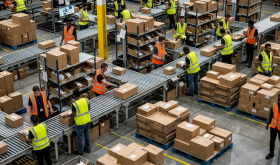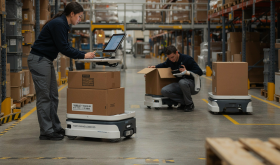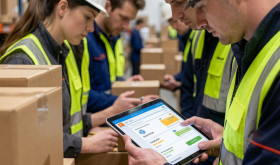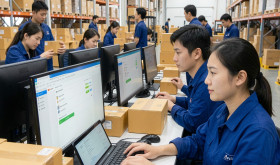
A warehouse management system is software designed to support the management of a company’s inventory, warehouse activities, workforce, and order fulfilment. By digitising these processes and enabling real-time management and automated operations, a warehouse management system helps businesses reduce costs, eliminate errors, and improve the customer experience.
A modern warehouse management system is a must for brands that need to manage omnichannel retail, e-commerce fulfilment, distribution chains, and third-party logistics. It is a strategic technology that supports businesses’ ability to scale as order volumes grow, delivery timelines shorten, inventory rules become more complex, and customer demands become more sophisticated.
What Is a Warehouse Management System?
A warehouse management system is a digital tool that directs and records a warehouse’s activities throughout the order lifecycle: from receipt and put-away through storage, replenishment, picking, packing, shipping, and returns to inventory counts.
Modern warehouse management systems employ barcode scanning, RFID, mobile devices, cloud technology, and integrations with ERP, e-commerce, transportation management systems, and order management systems to give businesses real-time insights into their stock levels and enable them to organise their fulfilment processes more effectively and productively.
A warehouse management system is a strategic tool for any business that wants to scale its operations. By digitising and standardising processes, it helps organizations eliminate inaccuracies, streamline operations, and boost productivity and customer satisfaction.
Improved Inventory Accuracy
One of the main advantages of a warehouse management system is that it provides businesses with better inventory accuracy. By digitising the processes and recording all movements in real-time, a warehouse management system enables a high level of inventory visibility and control.
Barcode scanners, RFID, or other forms of warehouse management system technology allow warehouse managers to know exactly what products are in stock, where they are located, how much is reserved, and when they need to be replenished.
With increased inventory accuracy comes greater warehouse productivity: there are fewer stock discrepancies, and therefore fewer errors during the picking process. In addition, accurate stock levels prevent overstocking and understocking, stock losses, additional rush orders, and financial reporting inaccuracies. Overall, businesses benefit from a better understanding of their stock situation and more accurate purchase planning.
Greater Operational Efficiency
A warehouse management system provides a clear picture of a warehouse’s day-to-day operations and helps it operate more efficiently. A warehouse management system takes over repetitive tasks associated with order processing, leaving more complex tasks to humans. Workers simply follow instructions provided by the system.
A warehouse management system typically reduces the distance travelled during picking and directs workers to the correct storage locations while picking. These productivity gains translate directly into cost savings.
Moreover, the efficiency of a warehouse management system grows with the warehouse’s needs. It allows businesses to scale during peak seasons and special promotions without additional costs and complexities. It also helps companies reduce the size of their warehouse staff.
Faster and More Accurate Order Fulfilment
Most customers today expect fast and accurate order processing. A warehouse management system helps businesses achieve high levels of speed and accuracy in order fulfilment, which results in more satisfied customers and fewer returns, complaints, and disputes.
A warehouse management system helps organise picking, pack, and shipping operations in such a way as to minimise the possibility of errors. For example, scanning helps to ensure that the right quantity of the right product is picked for a particular order.
A warehouse management system also helps businesses to respond to customer demands while maintaining the highest standards of quality and compliance. A warehouse management system typically offers various order management capabilities: processing single or multiple orders, bulk orders, order splits, click-and-collect options, omnichannel return management, and other functions.
Through these tools, businesses can choose the best way to deliver goods to customers and differentiate themselves from competitors.
Better Labour Productivity and Planning
A warehouse’s operating costs are often directly related to staff costs, making productivity a priority for any warehouse manager. A warehouse management system helps to optimise the workforce by analysing the tasks at hand and assigning them to workers based on their skills, equipment, and proximity. A warehouse management system makes it possible to measure and analyse performance by task, shift, zone, or employee. This helps to identify inefficiencies and improve performance.
In addition, a warehouse management system helps to plan staff capacity: by analysing the expected order volume, the warehouse management system can determine how many workers will be needed for specific tasks. This reduces staff costs and improves responsiveness during peak seasons.
Rather than guessing at average response times or staff performance levels, warehouse managers can rely on real-time data to get an accurate picture of their workforce performance and capacity.
Optimised Warehouse Space Utilisation
Warehouse storage space is a precious asset. A warehouse management system helps businesses maximize their storage capacity while minimising the costs associated with maintaining this asset. Using analytics and automation, a warehouse management system helps businesses organise their warehouse in a way that minimises space wastage and accelerates order processing.
For example, products that are reordered most often can be placed in the most accessible locations to speed up picking and reduce the distance travelled by pickers. Moreover, by optimising racking and aisle space, a warehouse management system can help a business defer additional warehouse leasing costs for as long as possible.
Reduced Costs and Waste
A warehouse management system helps companies reduce costs in several key areas: picking accuracy, manual inventory counts, labour costs, inventory shrinkage, and storage space. With a warehouse management system, businesses can reduce picking errors and the associated costs of remnant inventory, product returns, and customer complaints.
The system also helps to minimise manual inventory counts and the costs associated with them. By automating processes and reducing the need for human intervention, a warehouse management system reduces the likelihood of errors and inconsistencies.
For businesses with perishable goods, date- or batch-specific inventory rules, a warehouse management system can reduce losses due to expired or faulty products.
Moreover, a warehouse management system reduces the risk of over-ordering by providing more accurate information about stock on hand, which ultimately lowers carrying costs. All of these factors contribute to a significant reduction in a warehouse’s overall costs.
Stronger Traceability and Compliance
Traceability is of particular importance in the food and beverage, pharmaceutical, medical device, automotive, and electronics manufacturing industries. A warehouse management system can help organisations implement more robust traceability practices, including tracking inventory by lot, batch, serial number, expiration date, or receipt date.
This information is crucial during product recalls, as it allows a business to quickly identify affected products, locate them in the warehouse, and determine where the affected goods have been shipped. Overall, a warehouse management system reduces the time, cost, and complexity of any product recall.
Moreover, a warehouse management system makes it easier to store electronic records of inventory records, which helps demonstrate compliance with regulatory, customer, or internal control requirements.
Data-Driven Decision Making and Supply Chain Resilience
A warehouse management system is a rich source of information about a warehouse’s performance. It tracks inventory data, order processing times, labour productivity, warehouse utilisation rates, and much more.
By analysing this data, a warehouse manager can identify trends and patterns and use this information to make more informed business decisions. For example, inventory data can be used to improve purchase planning and reduce costs. Information about order processing speeds can be used to identify and resolve bottlenecks.
At the strategic level, a warehouse management system gives managers the information they need to identify opportunities for improvement. Many modern warehouse management systems incorporate AI, machine learning, robotics, and other technologies to help warehouses operate more efficiently and become more resilient in the face of supply chain disruptions.
How a Warehouse Management System Drives Business Growth
The advantages of a warehouse management system are numerous and multifaceted. Inventory accuracy leads to faster fulfilment and higher customer satisfaction. Higher productivity and better space utilisation lead to cost savings and maximised capacity. Comprehensive traceability, better reporting, and stronger compliance contribute to the customer experience and long-term growth. These factors, in turn, contribute to the bottom line.
A warehouse management system can be a growth enabler for any business that sells its products through multiple channels, manages large product inventories and complex distribution networks, experiences seasonal demand fluctuations, plans to scale its operations, or seeks to become more efficient and customer-centric.
The Right Warehouse Management System for Your Business Needs
When choosing a warehouse management system, it is important to focus not only on the inventory management functions but also on the broader organisational needs. A warehouse management system must be able to provide accurate inventory information and automate processes wherever possible. It must be able to direct pickers, put-away, replenish, and organise warehouse space.
At the same time, a warehouse management system must be able to integrate with other systems: ERP, e-commerce, order management, and transportation management systems, among others. It should also provide reporting and tracing functions that support day-to-day operations, as well as strategic-level decision-making.
Finally, it is important to choose a warehouse management system that will best support your business’s current and future needs. You may want to consider the software’s implementation roadmap and your ability to adopt and use new features.
Final Thoughts
A warehouse management system helps businesses maximise the value of their inventory, workforce, and warehouse space while minimising costs and errors. Through its advanced analytics and reporting capabilities, a warehouse management system helps a business turn raw data into actionable insights that drive growth and operational efficiency.