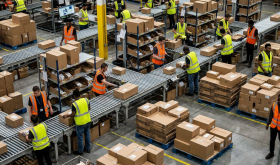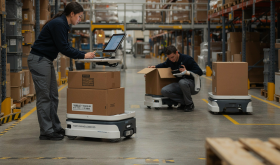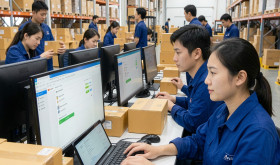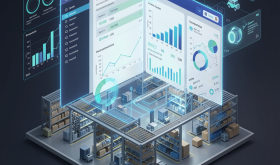
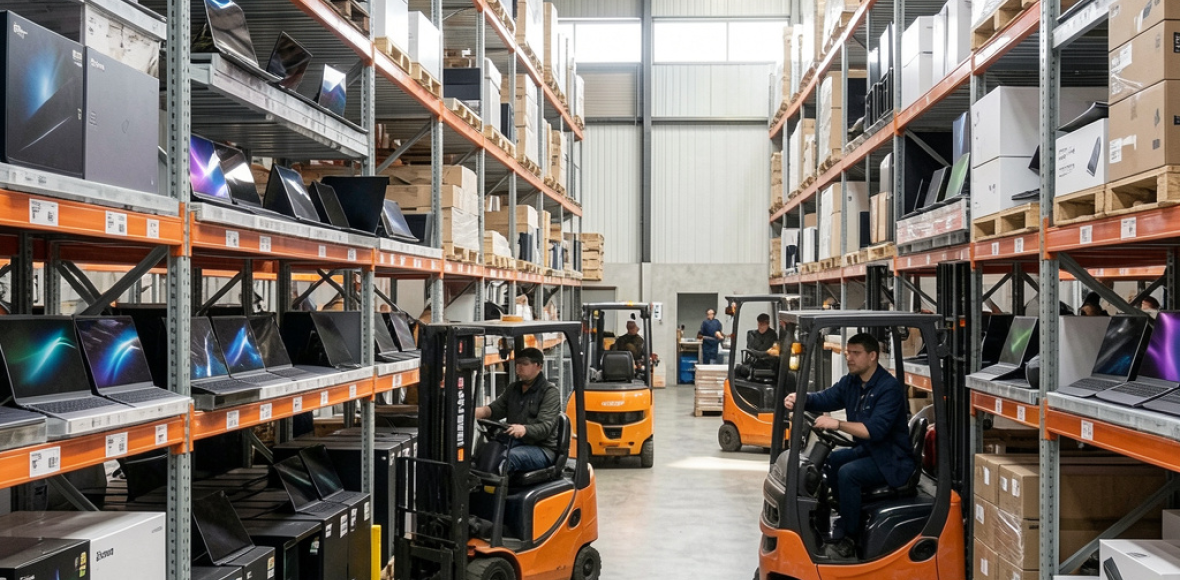
In recent years, warehouses have come to be regarded as one of the most strategic assets in contemporary business. In light of increasing consumer demands for same-day shipping, instant order tracking, and perfect precision, the pressures on warehouse operations are higher than ever before. Manual processes, spreadsheets, and unconnected systems that previously were more than enough have become major hindrances that bring inaccuracies and inefficiencies and create blind spots throughout the entire chain of supply.
The use of a warehouse management system is the solution to all those problems. This is a software system aimed at managing and optimising each and every process within warehouse operations from the moment when goods enter the warehouse until the moment when the orders are fulfilled. Instead of depending on manual counting, paper pick lists, and scattered data, a warehouse management system offers businesses one real-time tool that contains information about all operations conducted in a warehouse.
This article highlights some of the basic advantages brought by warehouse management system.
1.Improved Inventory Accuracy and Visibility
One advantage, which can perhaps be considered the most important one of all the benefits of a warehouse management system, is that of inventory accuracy. Human error is bound to occur when people handle inventory in an inefficient manner, with the result being that there is often a great discrepancy in their records of inventory. Such errors prove to be costly because they often lead to inventory stockouts or overstocking.
With the help of barcode scanning, RFID technology, and the use of real-time data capture methods, a warehouse management system helps keep track of every little movement of inventory, from the time it is received to its storage and then onwards to its shipment. Every little thing that happens is recorded immediately. With this system in place, inventory managers are able to see for themselves what inventory they have on hand, where it is located, and how much of it can be promised to the customers.
2. Increased Operational Efficiency
Warehouses are intricate operations with numerous processes working simultaneously with one another, namely receiving, put-away, picking, packing, and shipping. All these processes need to be optimised individually and collectively as well with the help of a warehouse management system.
For instance, a warehouse management system helps identify the most efficient location to store goods, taking into consideration the velocity of their movement, sizes, and storage requirements. When performing picking, the warehouse management system helps create pick paths that are optimal from the point of view of walking distance reduction and order batching and guides workers with picking using pick-to-light, voice picking, or mobile scanning technologies. All these features alone have the potential of substantially decreasing time required to perform picking manually and using paper forms.
Besides the optimisation of separate processes, the warehouse management system allows managing all the workflow in the warehouse. Namely, it allows assigning tasks to workers based on their proximity to these tasks and balancing workload across different shifts and sequencing outbound shipments based on carriers’ requirements.
3. Reduced Labor Costs and Better Workforce Utilisation
Labour is typically the biggest expense when it comes to running the warehouse. A warehouse management system allows companies to make the most out of every labour hour because it eliminates wasteful motion, eliminates rework resulting from mistakes, and makes workforce planning data-driven.
A warehouse management system with its labour management functionality enables companies to measure productivity per individual or team, compare it with the benchmarks, and know where more training is required. It allows managers to see which jobs take longer than they should and reassign employees on the spot, rather than discover inefficient processes only after the fact.
This does not always translate into having less labour; it simply means that every labour hour works harder. Many companies find out that thanks to a warehouse management system, they can deal with large increases in their volume without proportionate staffing increases.
4. Faster, More Accurate Order Fulfilment
When customers have come to expect fast deliveries and accuracy when placing their orders, fulfilment speed and accuracy make all the difference. A warehouse management system will help in doing so directly.
The automated nature of picking and packing processes through the use of a warehouse management system means less chance of error due to mis-picking and incorrect shipping based on manual list systems. The integrated verification process, which includes scanning barcodes at every step of the way, guarantees the proper product is included in the proper quantity and shipped in the right order. The end result? Fewer returns, fewer complaints, and less cost associated with having to re-ship products.
On the other hand, the efficiency improvements mentioned above can also help companies deliver much faster order cycle times. An order that used to take several hours to complete may now only take minutes thanks to a warehouse management system.
5. Better Space Utilisation
Warehouse space is costly, and any inefficiency in the use of the space has a direct effect on profit. A warehouse management system enables companies to maximise space through intelligent management of storage areas using the properties of the items and the space available.
Slotting optimisation, which is one of the features of a warehouse management system, enables fast-moving items to be stored in easy-to-reach areas and slow-moving items to be stored in other areas. By doing this, the picker can spend less time walking while maximising the use of all warehouse space. Slotting optimisation in a warehouse management system can change according to the changing demand for items, which cannot be achieved manually.
More efficient use of warehouse space saves costs on expansion.
6. Enhanced Supply Chain Visibility and Integration
The warehouse management system is not a stand-alone process. The contemporary warehouse management systems work in tandem with the enterprise resource planning (ERP) systems, transportation management systems (TMS), e-commerce portals, and other supply chain technology. In doing so, such connectivity results in a connected information flow along the entire supply chain rather than islands of information.
As a result of the connectivity, companies get a full end-to-end view of operations from the purchase order till the last delivery. The sales and customer service teams are able to see the current status of orders and inventory without having to check the information with the warehouse. Financial departments have access to the more accurate information, which will help them report and forecast. Logistics teams become able to synchronise inbound and outbound logistics, thus reducing the congestion on the dock and coordinating carriers’ schedules.
The information flow becomes very important during the interruptions of the supply chain caused by weather conditions, logistics problems, and issues with suppliers.
7. Scalability to Support Business Growth
As an enterprise grows in size by taking more orders, introducing new products or venturing into other markets, its warehouse activities need to grow alongside. The manual way of carrying out these activities tends to slow down an enterprise’s rate of growth since it demands much more effort and management.
A warehouse management system is designed to be scalable. If a company is introducing more SKUs, setting up new warehouses, or facing a surge in volumes for some time, a warehouse management system has the ability to accommodate the changes without having to redesign its operations entirely. Cloud-based warehouse management system solutions provide such flexibility to scale up or down at will.
8. Improved Compliance and Traceability
In cases where industries are required to follow certain regulatory requirements, such as the food and beverages industry, the pharmaceutical industry, and consumer products, traceability becomes an essential part. The warehouse management system helps provide the needed tracking of such requirements as lot tracking, expiration date tracking, and serial number tracking.
In case there is a product recall, a warehouse management system will be able to pinpoint all the products that need to be recalled easily, hence saving the costs of the recall process and its complexity.
9. Data-Driven Decision Making
All transactions performed using the warehouse management system have a certain data content, which is a resource of great value in its own right. Modern systems for managing warehouses provide for a reporting and analytical component that converts all raw operation-related data into useful information.
Trends in the number of orders placed and the values of various KPIs, such as order accuracy and delivery speed, as well as the identification of bottlenecks in the workflow, which allows managers to prevent serious problems from arising in advance, are just some examples of this type of data.
Moreover, this data can be used not only for current decision-making but also for future strategic planning.
Conclusion
The advantages of a warehouse management system go much further than merely monitoring stock. Improving accuracy and efficiency, lowering costs, scaling operations, making informed decisions, and many other advantages—all these are possible through the implementation of a warehouse management system. In today’s world when customers’ expectations only grow and margins keep shrinking, a WMS provides important opportunities for business owners that cannot be overlooked.
Organisations that decide to maintain old manual systems and avoid introducing a warehouse management system into their operation will be left behind by their rivals that use this system. At the same time, organisations that invest in such a warehouse management system will be better equipped to handle their processes in a more effective way and better serve their customers. Given that in today’s world warehouses have become an increasingly important component of business success, the warehouse management system has become not optional but a must-have for any company.
« Navigating the “Logistics Ceiling”: How TMS, Route Optimisation, and ePOD are Reshaping Southeast Asian TransportationOrder Management System for SMEs and Enterprises: A Complete Guide »